
Conservatory Roof Replacement: Options and What to Expect
A conservatory roof replacement is usually considered when the existing roof is no longer performing well enough in terms of comfort, heat retention, noise control, condensation resistance or day-to-day usability. In many cases, the issue is not simply that the roof is “old”. The real problem is that the existing build-up allows too much heat transfer, too much solar gain, or too much temperature instability across the room.
That is why conservatory roof replacement is often less about appearance alone and more about improving the thermal and practical performance of the space.
For homeowners, the main question is usually not whether a replacement roof looks better. It is whether the new roof system will make the conservatory more usable, more stable in temperature and better suited to year-round living.
Why homeowners consider conservatory roof replacement
Older conservatory roofs, especially ageing polycarbonate or underperforming glazed systems, can create several technical and comfort-related problems:
- high solar gain in warmer months
- rapid heat loss in colder weather
- cold internal surface temperatures
- increased risk of condensation
- poor acoustic performance during rain
- limited thermal stability throughout the day
In building performance terms, the roof is often the weakest part of the conservatory envelope. Because warm air rises, the roof has a major influence on heat loss, internal surface temperature and perceived comfort. If the roof performs poorly, the room may feel too hot, too cold, noisy or damp, even if the rest of the structure is still sound.
That is why replacement conservatory roof solutions are often explored as a way to upgrade the overall function of the space rather than just its appearance.
What a conservatory roof replacement is designed to improve
A new conservatory roof should aim to improve several things at once.
1. Thermal performance
One of the main technical goals is to reduce heat transfer through the roof. A better-insulated roof build-up helps slow heat loss in winter and reduce heat gain in summer.
2. Internal surface temperature
Cold internal surfaces contribute to discomfort and condensation risk. A better roof system can help maintain a warmer internal face, which supports a more stable internal environment.
3. Structural efficiency
A replacement roof has to work within the limits of the existing conservatory structure. That is why lightweight conservatory roof options are popular. They provide improved insulation and finish without imposing the same loading as a traditional heavyweight roof construction.
4. Weather performance
A replacement roof will improve resistance to rain noise, wind exposure and temperature swings, while maintaining good detailing around connections, flashings and roof junctions.
5. Overall usability
For many homeowners, the real success of a conservatory roof replacement is whether the room becomes usable for more months of the year and more comfortable for everyday living.
The main conservatory roof replacement options
There is no single replacement roof type that suits every conservatory. The right option depends on the existing structure, the performance target, planning considerations, visual preferences and budget.
Lightweight conservatory roof
A lightweight conservatory roof is designed to reduce unnecessary structural load while improving insulation and internal finish.
From a technical perspective, this matters because the existing frames, wall plates and foundations of the conservatory may not be suitable for a much heavier roof build-up. Lightweight systems are often chosen where homeowners want improved thermal performance without moving to a traditional heavy roof solution.
A lightweight conservatory roof will include:
- a lightweight structural framework
- high-performance insulation layers
- breathable membranes
- internal plastered or panelled finishes
- lightweight external coverings, tiled-effect systems
The main advantage is that the system can improve performance while staying more compatible with the original conservatory structure.
Insulated conservatory roof
An insulated conservatory roof is intended to improve heat retention and reduce the severity of internal temperature swings. In technical terms, insulation helps reduce conductive heat transfer through the roof build-up.
This will support:
- lower heat loss in colder periods
- reduced overheating in warm weather
- more stable internal temperatures
- warmer internal roof surfaces
- better comfort across the room
An insulated conservatory roof does not always mean a full heavyweight roof conversion. In some cases, the improvement comes from the layered construction of the system and how effectively it reduces thermal movement through the roof zone.
Warm conservatory roof
A warm conservatory roof generally refers to a roof build-up where insulation is placed in a way that helps keep the structural elements and inner layers closer to internal temperature conditions.
The purpose of this type of build-up is to reduce cold bridging and improve internal thermal consistency. In practical terms, this can help reduce discomfort caused by cold surfaces, and in some conservatories it may also help reduce the conditions that lead to recurring condensation.
Warm roof conservatory solutions are often attractive because they aim to improve comfort without leaving key parts of the roof construction thermally exposed.
Tiled conservatory roof replacement
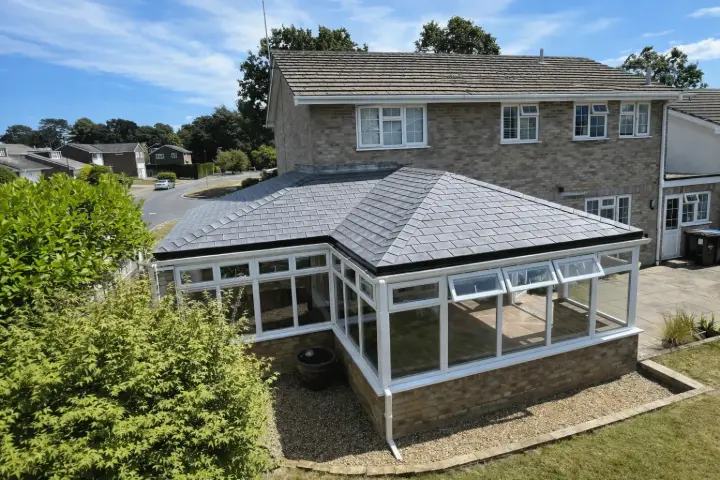
A tiled conservatory roof replacement is often chosen when homeowners want a more solid appearance and improved performance compared with older transparent or translucent roof systems.
Technically, a tiled system will offer:
- improved acoustic control
- reduced direct solar gain
- better thermal layering
- a more room-like internal ceiling finish
However, tiled conservatory roof replacement options always need to be assessed in relation to structural loading. Not every existing conservatory can simply accept a new roof without considering whether the frames and base are suitable.
That is one reason lightweight tiled conservatory roof systems have become more popular. They aim to deliver the appearance and performance benefits of a tiled roof while remaining more structurally appropriate for conservatories.
What to expect from the replacement process
Although the exact process depends on the roof type and installer, homeowners should normally expect a conservatory roof replacement project to involve the following stages.
Assessment of the existing conservatory
Before selecting a replacement roof, the existing conservatory should be checked for:
- condition of frames and wall plates
- structural suitability for the proposed roof type
- signs of movement, weakness or deterioration
- current roof configuration and geometry
- compatibility with insulation and internal finishing options
This stage matters because the success of a new roof depends not only on the new system itself, but also on how well it integrates with the existing structure.
Selection of the roof system
At this stage, the decision typically comes down to balancing performance, design, and how you want the space to feel day-to-day. The most common options are:
- Lightweight tiled roof systems
- Insulated roof panels
- Fibreglass roofs
- Insulated ceilings
The best replacement conservatory roof is not always the heaviest or the most expensive-looking option. It is the one that delivers the right balance between structural compatibility, thermal performance and long-term usability.
Installation and detailing
A good installation is about more than placing a new roof on top of old frames. Technical detailing matters.
Important areas include:
- junction detailing with the house wall
- weatherproofing and flashings
- insulation continuity
- ventilation strategy where relevant
- internal ceiling finish
- perimeter sealing and trim details
Poor detailing can compromise the performance of even a technically good roof system. That is why installation quality is just as important as the specification itself.
Internal finish and room feel
One of the biggest changes after a conservatory roof replacement is the feel of the room from inside. A better-insulated roof with an improved internal finish can make the space feel more like a true extension of the home and less like a highly exposed glazed structure.
This change in perceived comfort often comes from three things:
- reduced temperature fluctuation
- less radiant cold from above
- improved acoustic softness inside the room
How 2Hot2Cold can help
2Hot2Cold focuses on improving conservatory comfort through technically considered upgrade solutions. That matters because many conservatories do not necessarily need every part of the structure rebuilt in order to perform better. In some cases, the biggest gains come from targeting the part of the envelope that is causing the most discomfort.
Where a full conservatory roof replacement is being considered, 2Hot2Cold can help homeowners better understand:
- whether the main issue is heat loss, overheating, condensation or poor roof performance
- whether a roof-level solution is appropriate
- whether a lightweight or insulated approach is likely to suit the existing structure
- how improving the internal thermal performance of the conservatory can change how the room behaves
For homeowners who are not ready for a full roof replacement, or where the main problem relates to cold internal roof surfaces and comfort from above, 2Hot2Cold’s insulated conservatory ceiling approach can provide a more focused solution.
From a technical standpoint, this helps by introducing an additional insulating layer below the existing roof zone, which can support:
- warmer internal ceiling surfaces
- reduced heat transfer through the upper part of the conservatory
- improved temperature stability inside the room
- lower exposure to cold-radiating roof surfaces
- better comfort for everyday use
That is important because many complaints that lead people to search for conservatory roof replacement are actually performance complaints: the room is too cold, too hot, too noisy or too prone to moisture problems. In some situations, addressing the ceiling and internal roof zone can meaningfully improve those conditions without necessarily changing the entire external roof build-up.
Roof replacement or internal upgrade?
This is often the real technical and practical question.
A full conservatory roof replacement may be the right path where:
- the existing roof is failing
- the external roof covering is no longer suitable
- structural or weatherproofing issues need to be resolved
- a full change in roof type is required
An internal upgrade-focused solution may be more appropriate where:
- the structure remains broadly serviceable
- the main problems relate to comfort and thermal performance
- the homeowner wants less disruption than a full roof replacement
- The goal is to enhance how the space performs and feels day-to-day, without necessarily requiring a full structural rebuild.
This is one of the areas where a project-led, performance-led approach is useful. The right answer depends on what is underperforming and what level of change is actually needed.
Final thoughts
Conservatory roof replacement is not only about changing what the roof looks like. It is about changing how the conservatory performs.
Whether the option is a lightweight conservatory roof, an insulated roof panel solution, a fibreglass roof or insulated ceiling, the key technical goals remain the same: improve thermal control, reduce temperature instability, support structural compatibility and create a room that feels more usable throughout the year.
For many homeowners, that process starts with understanding what the current roof is failing to do. From there, the right solution can be chosen more intelligently.
2Hot2Cold helps by focusing on that performance problem directly. Whether the right route is a full replacement strategy or a more targeted internal roof upgrade, the aim is the same: a conservatory that feels more comfortable, more thermally stable and more practical as part of the home.