
Condensation in a conservatory is not just a surface-level annoyance. It is usually a sign that warm, moisture-laden air is meeting internal surfaces that are too cold. In many conservatories, this happens because the room heats up quickly, cools down quickly, and has poor thermal consistency across the roof, frames and glazing.
That is why condensation often appears first on the roof, roof bars and windows. The problem is especially common in conservatories with older polycarbonate roofs, lightweight glazing systems, poor ventilation or low internal surface temperatures during colder parts of the day.
If you want to stop condensation in a conservatory properly, it helps to understand the building physics behind it. Condensation is not random. It forms when humid air reaches its dew point on a colder surface. The lower the temperature of that surface, and the higher the moisture level in the room, the more likely visible water droplets are to form.
What causes condensation in a conservatory?
Condensation in a conservatory forms when three conditions come together:
- there is enough moisture in the air
- there is limited air movement or ventilation
- internal surfaces are cold enough for moisture to condense
Conservatories are particularly prone to this because they often have a high proportion of glazing and roof area relative to floor area. They also tend to experience larger temperature swings than the rest of the home.
A typical cycle looks like this:
- The room gains heat during the day from solar gain, background heating or warm air from adjoining rooms.
- The air inside the conservatory holds moisture from breathing, drying clothes, cooking nearby, plants or general household humidity.
- As outside temperatures drop, the roof and glazing cool rapidly.
- When the warm humid air touches those colder surfaces, condensation appears.
This is why conservatory condensation is often worse in the morning, in colder months, or after periods of poor ventilation.
Why is condensation worse on a conservatory roof?
Warm air rises, so the highest point of the room naturally becomes the main area where moisture-laden air gathers. If the conservatory roof has low insulation performance, the internal face of the roof can become cold enough for moisture to condense very quickly.
This is one of the main reasons conservatory roof condensation is such a common complaint.
In technical terms, the issue is linked to internal surface temperature. Even if the room itself feels reasonably warm for part of the day, the inside face of the roof may still be cold. When that internal surface temperature drops below the dew point of the air inside the room, moisture forms on the surface.
This is also why condensation on conservatory roof panels may keep returning even when homeowners are opening windows or wiping surfaces down. Ventilation helps, but if the roof build-up still allows the internal face to run cold, the root cause is not fully resolved.
The main factors that make conservatory condensation worse

1. Poor thermal performance of the roof
Older conservatory roofs often struggle to maintain stable internal surface temperatures. Polycarbonate and older glazed roof systems are especially vulnerable because they can lose heat quickly when outside temperatures fall.
2. High humidity levels
Moisture from everyday living builds up fast in enclosed spaces. Even if the conservatory is not the main source of humidity, air moving from kitchens, utility rooms or the main house can carry a lot of moisture into it.
3. Inconsistent heating
A conservatory that is very cold overnight and then heated suddenly in the morning can create ideal conditions for condensation. The air warms faster than the roof structure.
4. Inadequate ventilation
Without regular air change, humid air stays trapped in the room. That trapped moisture then settles on the coldest surfaces.
5. Thermal bridging
Some conservatories have roof bars, junctions and frame details that create colder spots. These localised cold areas can attract condensation even when other parts of the room look dry.
How to stop condensation in a conservatory
If you want to know how to stop condensation in a conservatory, the most effective approach is to address both sides of the problem:
- reduce moisture in the air
- increase internal surface temperatures
Doing only one of these may help, but usually will not solve the issue completely.
Step 1: Improve ventilation
Ventilation reduces the amount of humid air trapped inside the conservatory. This lowers the moisture load and makes condensation less likely.
Practical options include:
- opening windows regularly where possible
- making sure trickle vents are working properly
- improving cross-ventilation through adjoining rooms
- using extractor fans in nearby kitchens or utility areas
- using a dehumidifier as a support measure
This is often the first step when trying to prevent condensation in a conservatory, but ventilation alone is usually not enough where the roof remains thermally weak.
Step 2: Reduce internal moisture load
Condensation risk increases when too much water vapour is introduced into the room. Common sources include:
- drying washing indoors
- cooking or boiling water nearby
- large numbers of plants
- steam moving through from kitchens or bathrooms
- poor airflow in an enclosed conservatory
If you reduce those sources, you reduce the amount of moisture available to condense.
Step 3: Stabilise the room temperature
Conservatories perform better when the temperature stays more stable. Sharp swings in temperature create greater contrast between warm air and cold surfaces.
Even low-level background heat can help more than short bursts of intense heating, because it reduces the chance of the roof and glazing dropping to very low internal surface temperatures.
Step 4: Improve the thermal performance of the room
This is where long-term improvement usually happens. If the internal surfaces of the roof remain too cold, condensation will tend to come back no matter how often it is wiped away.
Improving the thermal performance of the conservatory helps by:
- raising internal surface temperatures
- reducing rapid heat loss
- making the room less prone to cold spots
- improving comfort and year-round usability
Short-term fixes vs long-term solutions
There is an important difference between managing condensation and solving the conditions that cause it.
Short-term fixes
These can help control symptoms:
- opening windows
- wiping moisture away
- running a dehumidifier
- reducing indoor humidity
- increasing airflow
These are useful, but they do not change the underlying thermal performance of the room.
Long-term solutions
These are aimed at reducing the conditions that allow condensation to form in the first place:
- improving insulation levels
- reducing cold internal roof surfaces
- improving overall heat retention
- making the conservatory more thermally stable
If condensation is persistent, the issue is often not just humidity. It is the combination of humidity plus a cold roof structure.
How 2Hot2Cold can help
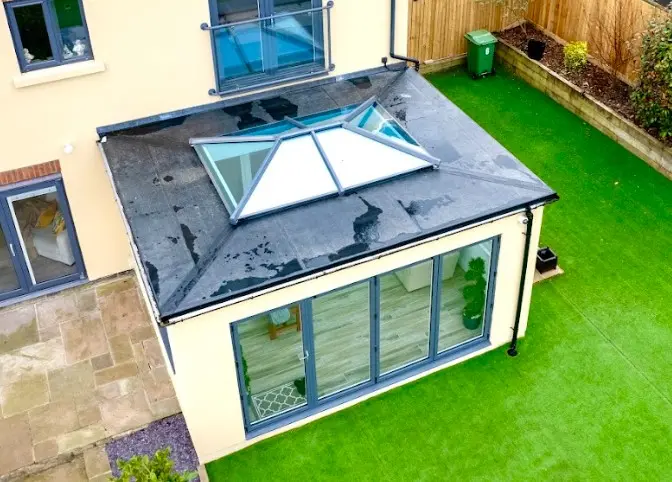
2Hot2Cold specialises in insulated conservatory ceiling systems designed to improve the internal performance of the space. From a technical point of view, that matters because condensation is strongly influenced by the temperature of the internal surface above your head.
When the internal face of the conservatory roof remains cold, moisture in the air is more likely to condense onto it. By installing an insulated conservatory ceiling, the room benefits from an added thermal layer that helps remove that cold-surface effect.
In practical terms, 2Hot2Cold can help by:
- creating a warmer internal ceiling surface
- reducing rapid heat transfer through the existing roof area
- lowering the likelihood of moisture forming on cold internal roof surfaces
- improving temperature stability within the conservatory
- making the room more usable across more months of the year
This does not just help with comfort. It can also help address one of the structural reasons condensation on a conservatory roof keeps returning.
A well-designed insulated conservatory ceiling system contributes to a controlled internal environment, where warm air is retained within the property.
Why an insulated conservatory ceiling can help with condensation
To be clear, condensation is not always caused by one issue alone. Ventilation and humidity still matter. But where the existing roof allows the internal surface temperature to fall too low, adding an insulated ceiling can make a meaningful difference.
The logic is straightforward:
- warmer internal ceiling surface
- no risk of reaching dew point on that surface
- no condensation forming overhead
That is why insulated conservatory ceilings are often considered not only for warmth and comfort, but also as part of a long-term strategy for removing conservatory condensation problems.
When condensation may point to a bigger performance issue
A small amount of condensation from time to time is normal. Persistent condensation is different.
It may indicate that the conservatory is suffering from:
- excessive heat loss
- low internal roof surface temperatures
- poor thermal consistency
- inadequate ventilation strategy
- moisture imbalance within the room
If you regularly see conservatory roof condensation, recurring dripping, mould growth or chronic dampness, it is worth looking beyond quick fixes and assessing whether the room is underperforming thermally.
Final thoughts
If you want to stop condensation in a conservatory, the most effective solution is usually a combination of moisture control, ventilation and improved thermal performance.
Short-term steps such as opening windows and using a dehumidifier can help reduce condensation in a conservatory. But where the roof remains cold internally, the problem often returns.
That is why long-term improvement matters. By helping to create a warmer internal ceiling surface and a more stable internal environment, 2Hot2Cold’s insulated conservatory ceiling systems can support a more effective solution to ongoing condensation issues, while also improving the comfort and usability of the space.